
You are about to swap tokens, bridge funds, or mint an asset on an EVM network. The fee estimate looks acceptable, so you install a browser wallet, import an account, and click through the prompts. Then the transaction simulation changes, the gas limit jumps, or the site asks for an approval that seems unrelated to the action you intended. In DeFi, the expensive mistake is not always a high gas fee. It may be signing the wrong message with the right wallet.
That is why a Rabby extension download should be treated as the beginning of a security process, not the end of one. A wallet browser extension is an interface between your private keys, a website, and a blockchain. It can make transaction intent easier to inspect, but it cannot make an unsafe protocol safe or recover assets sent to a fraudulent address. The useful mental model is simple: wallet security is primarily about controlling what you authorize, while gas optimization is about controlling the cost of that authorization.
The download decision is part of the threat model
Browser extensions are powerful because they can interact directly with decentralized applications, or dapps. They are also exposed to a crowded environment of advertisements, search results, cloned websites, and misleading “support” pages. A malicious extension or fake installation guide may imitate familiar branding while asking for a recovery phrase. That phrase is not a password that a legitimate wallet representative needs; it is the material from which control of the account can be reconstructed.
For US users, the practical installation rule is the same whether the wallet will be used on Ethereum, an Ethereum layer-2 network, or another EVM-compatible chain: start from a source you can independently verify, check the browser’s extension publisher and permissions, and compare the extension listing with the project’s official web presence. If you use a rabby wallet download guide, treat it as an orientation point rather than proof of authenticity. Never paste a seed phrase into a webpage, chat window, form, or pop-up, and do not assume that a polished interface is evidence of legitimacy.
A safer setup also separates roles. A small hot wallet can be used for routine swaps and experimentation, while larger holdings remain in a hardware wallet or another account with stricter signing procedures. This is not perfect compartmentalization: a compromised dapp can still waste time, expose public transaction history, or cause losses from the active account. But it limits the blast radius. Security is often less about eliminating every possible failure than about ensuring that one failure does not become a total one.
What a transaction simulator can and cannot tell you
Wallet interfaces increasingly try to show what a transaction is expected to do before it is signed. That is valuable because raw calldata—the encoded instructions sent to a smart contract—is unreadable to most people. A simulation can translate those instructions into a more understandable result, such as “send these tokens,” “receive this asset,” or “grant spending permission.” It can also reveal that a transaction will revert, meaning the blockchain is likely to reject it while still charging some network cost.
Yet simulation is not the same as a guarantee. It is a forecast based on a particular blockchain state and an interpretation of contract behavior. State can change between simulation and confirmation. A token may have unusual transfer logic. A contract may depend on external data, block timing, or conditions that are difficult to model. A warning should prompt investigation, but a clean-looking result should not replace judgment.
The most important distinction is between an action and an authorization. A swap may require permission for a decentralized exchange contract to spend a token. That approval can remain active after the swap and may permit future spending up to a stated amount—or, in some designs, an effectively unlimited amount. Users often focus on the immediate transfer and overlook the longer-lived permission. Before signing, ask two separate questions: what leaves my wallet now, and what authority does this contract retain afterward?
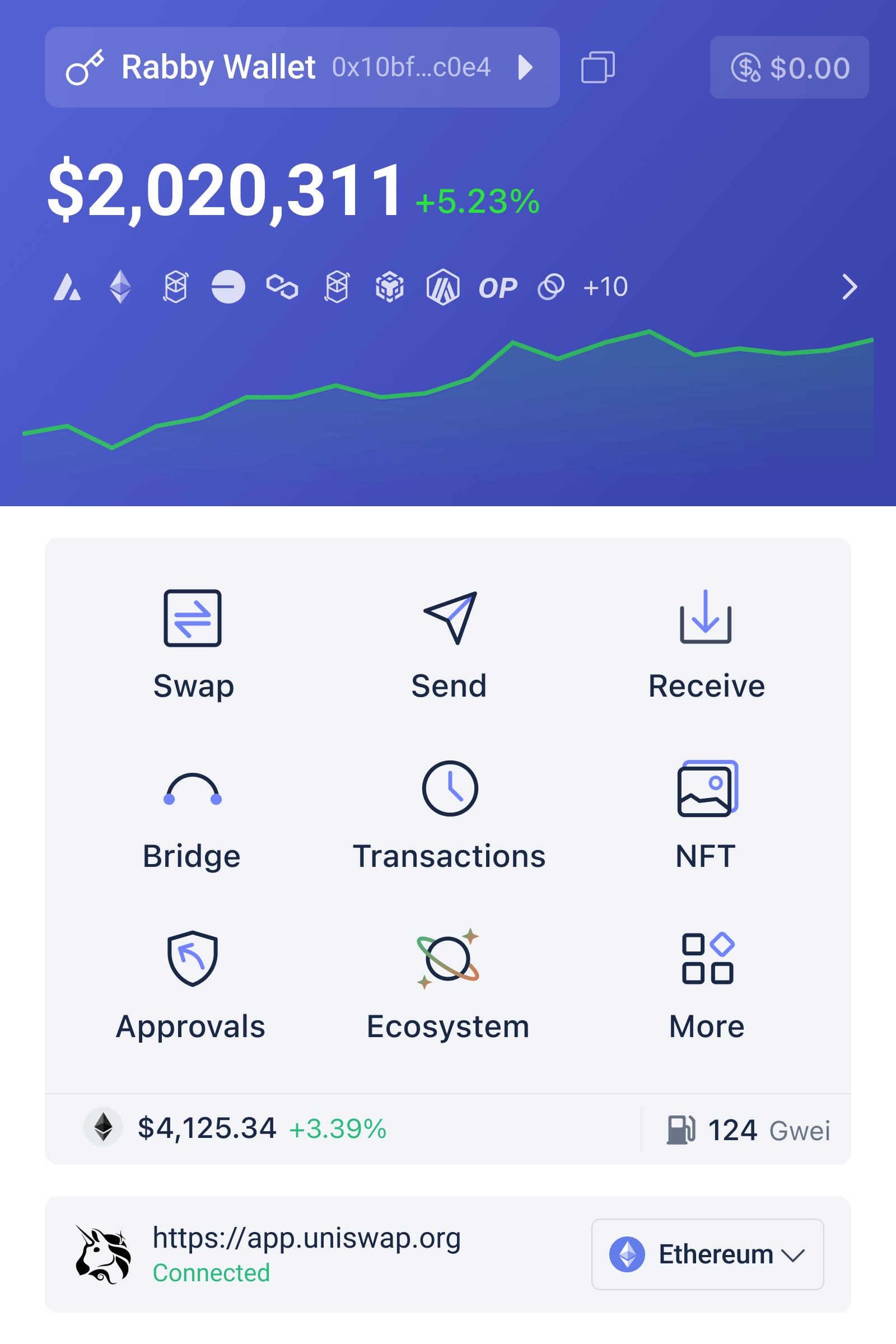
This is where a wallet such as Rabby can be useful as an inspection layer across Ethereum and EVM networks. Its value is not that it removes the need to read carefully. Its value is that it can organize chain context, contract interaction, and expected outcomes in one place. The limitation remains fundamental: a wallet can improve visibility, but it cannot audit every protocol, identify every economic exploit, or know whether a project’s team will behave responsibly.
Gas optimization is mostly about avoiding waste
Gas is the computation budget used to execute operations on an EVM blockchain. Users pay for gas in the network’s native asset, while the final fee depends on both the amount of computation and the price of that computation at the time the transaction is included. On Ethereum mainnet, demand can make the same action expensive at one moment and cheaper later. On layer-2 networks, fees are often lower, but they are not free and can include costs related to posting data back to the underlying chain.
Many users try to optimize gas by changing the gas limit manually. That is usually the wrong first move. The gas limit is the maximum amount of computation the transaction may consume; setting it too low can cause failure, while setting it higher does not necessarily mean you will pay the entire limit. The better starting point is to avoid unnecessary transactions and inspect whether the proposed action is actually needed.
Approvals are a common source of avoidable cost. A token swap may involve one transaction to approve spending and a second to execute the swap. Some applications support permit-style signatures that can reduce on-chain steps, although the signature itself still creates authorization risk and not every token or protocol supports the same method. If you interact with a protocol repeatedly, a broader approval may save future approval transactions, but it increases exposure if the approved contract is compromised or later behaves differently. A limited approval can reduce that risk while costing more over time.
Batching can also reduce overhead when a protocol supports it. Several related actions may be combined into one transaction, but batching is not automatically cheaper: a complex batch can consume more computation, and a failed step may affect the whole operation. The right comparison is not “one transaction versus two.” It is total expected cost, including failure risk, approval persistence, slippage, and the value of the time saved.
Another practical technique is timing. If an action is not urgent, watching network conditions may help avoid a demand spike. But waiting has a trade-off: prices can move, liquidity can change, and a transaction opportunity may disappear. A lower gas quote is not a saving if the asset moves against you by more than the fee difference. Gas optimization is therefore a portfolio decision in miniature, not merely a technical setting.
A reusable pre-signing framework
Before confirming a DeFi transaction, run four checks. First, identity: am I on the expected website, chain, and contract address? Second, effect: what assets will move, and what will I receive if conditions remain unchanged? Third, authority: does the transaction create an approval, permit, or other continuing permission? Fourth, economics: what are the gas cost, slippage, price impact, and likely cost of failure?
This framework catches a subtle category error. Users often treat gas as the main risk because it is the number displayed most prominently. In many transactions, however, the fee is known and bounded while the approval or contract interaction creates the larger uncertainty. A transaction costing a few dollars can expose far more value than the fee itself. Conversely, refusing a moderately expensive transaction may be irrational if a delay creates a much larger market loss. Security and optimization must be evaluated together.
After using a new dapp, review active token allowances when practical and revoke permissions that no longer serve a purpose. Revocation is itself an on-chain transaction, so it has a gas cost. That creates a boundary condition: revoking every approval immediately may cost more than the risk reduction justifies for a low-value wallet, while leaving broad permissions on a high-value account is difficult to defend. Match the response to the value at risk, contract trust, and how often the account is used.
What to watch as wallet interfaces develop
Recent Rabby messaging emphasizes use across Ethereum and EVM chains, including Chrome and Brave. The important trend is not simply support for more networks. It is the pressure on wallet interfaces to become interpretation tools rather than passive signing windows. As users move between mainnet, layer-2 networks, and application-specific chains, chain selection errors and confusing fee displays become more consequential.
That direction could improve safety if simulations become clearer, permissions are easier to manage, and network context is harder to miss. It could also create a new dependency: users may trust a wallet’s visual summary without understanding how the summary was produced. The signal worth watching is whether interfaces expose uncertainty and contract permissions plainly, rather than presenting every result as a confident prediction. Better design should make skepticism easier, not make skepticism unnecessary.
Frequently asked questions
Is downloading a wallet extension enough to secure my DeFi funds?
No. A reputable extension can help you inspect transactions and separate accounts, but security also depends on the installation source, recovery-phrase handling, device hygiene, dapp selection, approvals, and signing behavior. The extension is one control in a larger system.
Should I always choose the lowest possible gas setting?
No. A gas limit that is too low can cause a transaction to fail, and a low fee setting may leave a time-sensitive transaction pending. Compare the fee with urgency, price movement, slippage, and failure risk. When the action is not urgent, waiting for calmer network demand may help; when it is urgent, certainty of inclusion may matter more than a small fee reduction.
Why can a transaction look safe but still be dangerous?
A transaction may produce an understandable immediate result while creating a persistent token allowance or interacting with a contract whose future behavior is uncertain. Review both the immediate asset movement and the authority granted after signing. That distinction is one of the most reusable habits in DeFi.
The safest wallet user is not the person who never encounters a warning or pays the lowest fee. It is the person who can explain what a transaction does, what permission it creates, what it costs, and what would happen if the protocol or market behaves differently than expected. Downloading the extension is the mechanical step. Building that explanation before every meaningful signature is the real security upgrade.